When you're building a family through surrogacy, the state where the pregnancy occurs matters more than most people realize at first.
State law determines when you become a legal parent, whether your agreement is enforceable, and how much uncertainty you carry if something doesn't go as planned.
Some states treat surrogacy contracts as void, while others limit who qualifies as an intended parent. California sits at the other end of that spectrum.
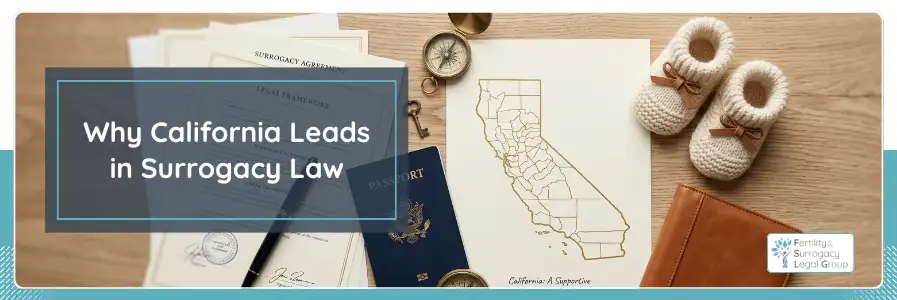
This post explains why California surrogacy law is considered the national standard, what the legal process actually involves, and what you should know before you start.
- California courts can issue a pre-birth order that names the intended parents as legal parents before the baby is born - no post-birth adoption required.
- Neither the intended parents nor the gestational surrogate needs to be a California resident for California law to apply.
- California law protects all family structures: married, unmarried, same-sex, single, and international intended parents are all recognized.
- The Gestational Surrogacy Agreement must be fully executed - with independent legal counsel on both sides - before any embryo transfer takes place.
- Compensating a gestational surrogate is fully legal in California; there is no prohibition on paid surrogacy arrangements.
- State selection is one of the most consequential early decisions you'll make - and it's one that's easy to get wrong without legal guidance.
Why California Surrogacy Law Sets the Standard
California's reputation isn't based on marketing. It's built on more than 30 years of case law that has consistently ruled in favor of intended parents and set legal precedents the rest of the country has followed.
It started with a landmark case.
In 1993, the California Supreme Court decided Johnson v. Calvert, a dispute between intended parents and their gestational surrogate over legal parentage. The court held that intent, not genetics or gestation, is the governing principle in surrogacy. The contract was enforceable. The intended parents were the legal parents.
Five years later, In re Marriage of Buzzanca went further, establishing that intended parents who have no biological connection to the child can still be recognized as legal parents based on their intent to create and raise that child.
These decisions gave California surrogacy law something most states still lack: a clear, tested foundation that courts know how to apply.
California has no single surrogacy statute. Instead, it operates under common law principles anchored by these cases, updated by the California Family Code. That flexibility is an advantage; it allows courts to protect intended parents in situations that more rigid statutory frameworks can't always accommodate.
Contracts are legally enforceable. Pre-birth orders are routinely granted. Compensation to gestational surrogates is permitted. And parental rights are not conditioned on marital status, sexual orientation, or genetic connection.
The Pre-Birth Order: Why It Matters So Much
A pre-birth order is a court order issued before delivery that establishes the intended parents as the legal parents of the child. It's arguably the single most important legal instrument in a California surrogacy arrangement.
When a pre-birth order is in place, the birth certificate lists the intended parents from day one. There's no gap in legal recognition. No post-birth adoption proceeding. No ambiguity in the delivery room.
In California, pre-birth orders are available to all intended parents regardless of marital status, sexual orientation, or whether donor eggs or sperm were used.
The petition is typically filed during the second trimester in the superior court of the county where the surrogate resides or where delivery will occur. In uncontested cases, it's generally resolved before birth.
Understanding the full scope of pre-birth and post-birth orders - including what happens when a pre-birth order isn't available - is worth reading before you match with a surrogate.
How California Compares to Other States
Not every state makes this process straightforward, and in some states, pursuing srrogacy is risky or even illegal. In Nebraska, surrogacy contracts are void and unenforceable, which means if a dispute arises, there's no legal agreement to stand behind.
In Louisiana, gestational surrogacy is permitted only under narrow conditions that exclude many LGBTQ+ families, single parents, and those using donor material.
California is in a different category entirely. But so are several other states, and understanding the differences matters, especially if your surrogate lives somewhere other than California.
| State | Pre-Birth Order | LGBTQ+ Protections | Residency Required | Contract Enforceability | FSLG Licensed |
|---|---|---|---|---|---|
| California | Yes - routinely granted | Explicit, established case law | None | Strong - common law + precedent | ✓ |
| Colorado | Yes | Yes | None | Strong | ✓ |
| Oregon | Yes | Yes - broad | None | Strong | ✓ |
| Washington | Yes | Yes - statutory | None | Strong (2019 statute) | ✓ |
| Florida | Yes - with conditions | Statutory protections | Surrogate must be FL resident | Strong under FL statute | ✓ |
| Texas | Yes | Improving; varies by case | None for IPs | Generally strong; less predictable | ✓ |
| Georgia | Yes | Developing | None for IPs | Solid, improving | ✓ |
The right jurisdiction for your arrangement depends on where your surrogate lives, where the birth will occur, and the specific facts of your case.
Each state page linked in the table above covers what those differences look like in practice.
What the Gestational Surrogacy Agreement Must Cover
The Gestational surrogacy agreement is the legal foundation of the entire arrangement. It isn't a formality - it's what makes everything else enforceable.
Under California Family Code Section 7962, the agreement must be signed by both parties before the embryo transfer takes place.
Both the intended parents and the gestational surrogate must have independent legal counsel, meaning separate attorneys, not the same one.
That separation protects everyone. It ensures your surrogate understood what she agreed to, and it ensures the agreement will hold up if it's ever challenged.
At a minimum, the agreement addresses:
- Compensation and expense reimbursement for the surrogate
- Medical decision-making authority during pregnancy
- Contact and communication expectations between the parties
- Insurance coverage and any gaps
- Selective reduction and termination provisions, handled carefully
- Legal parentage - the parties' stated intent
Once the agreement is fully executed, the IVF clinic receives a formal legal clearance letter confirming all legal requirements have been met and that the medical protocol can proceed. Clinics should not move forward without it.
Who Does This Legal Framework Protect
Same-sex couples and LGBTQ+ individuals have relied on California surrogacy law for decades because the state has never conditioned parental rights on the sex or sexual orientation of the intended parents. California courts have recognized same-sex couples, transgender individuals, and non-binary parents consistently and without exception.
If this describes your family, the LGBTQ+ family-building resources and same-sex couple guidance on this site go deeper into what the process looks like for you specifically.
International intended parents choose California in large numbers because there's no residency requirement and because California courts have handled international surrogacy arrangements long enough to have clear, predictable processes.
After birth, families returning abroad typically need passport and travel documentation processed before they can go home. That step is part of the legal process, not an afterthought.
Single intended parents can establish sole legal parentage through the California pre-birth order process. The state has consistently recognized single-parent surrogacy arrangements.
Anyone whose surrogate lives in California will follow California surrogacy law for the parentage proceedings, regardless of where the intended parents are based.
Three Mistakes That Create Real Problems
Starting the medical process before the agreement is signed
The Gestational Surrogacy Agreement must be fully executed - with both parties represented by independent counsel - before any embryo transfer. This isn't a technicality. An agreement signed after transfer is legally vulnerable and may not protect anyone if something goes wrong. The legal clearance letter to the clinic exists specifically to enforce this checkpoint.
Treating the agency as the legal team
Agencies coordinate matching, screening, and support. They don't practice law, and they cannot draft enforceable agreements or file court petitions. You need a separate attorney regardless of which agency you work with or whether you're doing an independent arrangement.
Filing the pre-birth order too late
The petition is typically filed in the second trimester. Waiting until the third trimester - or after delivery - creates avoidable complications at the hospital and risks the birth certificate not reflecting the intended parents correctly. File on time, and the delivery room is one less thing to worry about.
Frequently Asked Questions About California Surrogacy Law
The Bottom Line
California surrogacy law gives intended parents something genuinely valuable: clarity before the birth, not scrambling after it. Pre-birth orders, enforceable contracts, no residency barriers, and protections that apply equally to every family structure are not a given in most states.
The framework holds up when it's followed correctly. That means getting legal counsel early, executing the Gestational Surrogacy Agreement before transfer, and filing the pre-birth order on time.
If you're at the beginning of this process and trying to understand what the legal path actually looks like, FSLG's attorneys have been guiding families through it since 2012. The first conversation is free. There's no pressure, and no obligation - just straight answers to real questions.
You deserve to go into this knowing exactly where you stand.

Rich Geisler is the principal and founder of Fertility & Surrogacy Legal Group, leveraging over a decade of expertise in fertility and third-party reproduction law to help clients worldwide build their families. A dedicated advocate and trusted advisor, Rich is an active member of the American Bar Association and a fellow in the Academy of Adoption and Assisted Reproduction Attorneys.