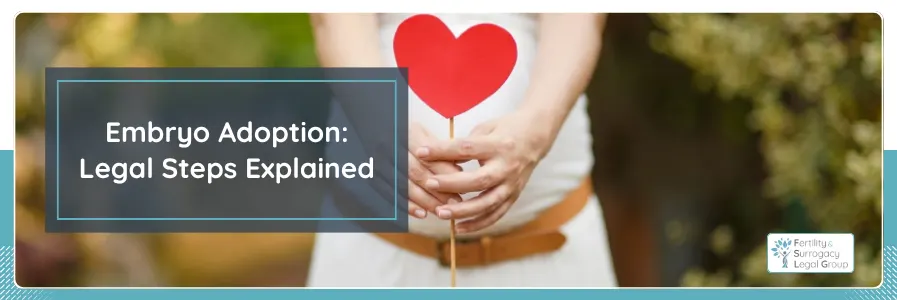
Millions of IVF cycles produce more embryos than families ultimately use. Some of those families choose to give their remaining embryos a chance at life by donating them, and for intended parents who cannot use their own eggs or sperm, receiving donated embryos can be a deeply meaningful path to parenthood.
But embryo adoption is not simply a medical procedure. It involves a specific legal framework that determines who is recognized as the child’s parent, what rights the donor family retains, and what happens if those questions are left unresolved.
This guide explains what embryo adoption is, how it differs from embryo donation, what the legal agreement must include, and who this path is best suited for.
- Embryo adoption is the process by which intended parents receive donated embryos from another family and carry the resulting pregnancy, with the intent of becoming the child’s legal parents.
- “Embryo adoption” and “embryo donation” are often used interchangeably, but they follow different legal frameworks — and which one applies in your state matters significantly.
- A legally binding embryo donation agreement is required before any target transfer takes place and must address parental rights, donor anonymity, genetic sibling contact, and future disposition of unused embryos.
- State law governs these agreements, and outcomes vary: states like California, Texas, and Florida each treat embryo donation differently from a parentage perspective.
- Both the donor family and the receiving family should have independent legal representation to ensure the agreement is enforceable and that each party’s interests are protected.
- Many intended parents – including LGBTQ+ families, single parents, and those who have experienced repeated IVF failure — choose embryo adoption because it offers a lower-cost path to pregnancy with a gestational connection.
What Is Embryo Adoption and What Does It Actually Mean Legally?
Embryo adoption is a widely used term, but it is a marketing term, not a legal one. Under U.S. law, an embryo is not a child; it is genetic material, and its transfer from one family to another is governed by contract law, not adoption law. The legally accurate term is embryo donation, and the legal instrument that makes it binding is an embryo donation agreement.
In practical terms, the process works like this: a family with cryopreserved embryos remaining after their own IVF treatment donates those embryos to intended parents.
The intended parents receive the embryos, attempt a frozen embryo transfer (FET), and, if the pregnancy is successful, are recognized as the child’s legal parents. The receiving parent may carry the pregnancy themselves, or a gestational carrier may carry it on their behalf.
The confusion between “embryo adoption” and “embryo donation” matters because some programs use the adoption framework – including home studies and agency placement processes – to structure the arrangement.
That framework carries additional requirements, costs, and legal implications that may not apply under a standard donation agreement. Understanding which structure applies to your situation, and in which state, is one of the first questions an ART attorney will help you answer.
“Embryo Adoption” vs. Embryo Donation: Understanding the Legal Difference
These terms are often used interchangeably, but they represent two distinct frameworks, and the one that applies to your arrangement has real legal consequences.
|
Dimension
|
“Embryo Adoption”
marketing term
|
Embryo Donation
legal framework
|
|---|---|---|
| What it actually is | A term used by some agencies to describe embryo placement, modeled after child adoption | The legally accurate term: a contract-based transfer of genetic material |
| Legal basis | May involve adoption-style home study and agency placement process | Governed by an embryo donation agreement under ART/contract law |
| How embryos are treated | Framed as a child being placed with a family | Treated as genetic material (property) being transferred |
| Home study required? | Sometimes, depending on the program structure | Generally not required |
| Parentage established via | Adoption decree or court order | Donation agreement + parentage order or birth certificate |
| Access | Some programs restrict eligibility | Available to all intended parents regardless of family structure |
| State law variation | Significant | Significant |
This distinction matters to families who have been told they must go through an adoption-style process. In most states, you do not. An ART attorney can help you understand what your state requires and which framework serves your family’s interests.
How the Embryo Adoption Process Works
The process unfolds across several stages, each with its own timeline and legal checkpoints.
Identify embryos and match with a donor
Timeline variesEmbryos may be located through a fertility clinic, an embryo donation program, or an independent match. Matching criteria typically include medical history, physical characteristics, open or closed arrangement preferences, and the donor’s wishes for future contact or updates.
Consult with a fertility attorney before signing anything
As early as possibleBefore any agreement is signed – or any transfer is scheduled – both parties need independent legal counsel. The receiving family’s attorney drafts or reviews the Embryo Donation Agreement; the donors have their own attorney review it on their behalf. This protects everyone.
Execute the Embryo Donation Agreement
Typically 2–3 weeksThe agreement is the legal foundation of the arrangement. It must be signed and fully executed before the embryo transfer takes place. This document explicitly dissolves any parental rights the donors may have over the embryos. See the legal section below for everything the agreement must include.
Legal clearance and medical preparation
Timeline variesOnce the agreement is finalized, FSLG sends a formal legal clearance letter to your IVF clinic, permitting them to initiate medical services. The receiving parent – or surrogate, if applicable – then undergoes medical evaluation and begins the hormonal preparation protocol prescribed by their reproductive endocrinologist.
Embryo transfer
The fertility clinic performs the frozen embryo transfer. Success rates vary based on embryo quality, the donor’s age at the time the embryos were created, and the recipient’s uterine environment. For current clinical benchmarks, the Society for Assisted Reproductive Technology (SART) publishes national embryo donation outcome data.
Establish legal parentage
If applicableIf an intended parent is carrying the pregnancy herself, her legal parentage is generally established upon birth, supported by the Embryo Donation Agreement. If you are also using a gestational surrogate to carry the donated embryos, your attorney will file for a pre-birth or post-birth order – depending on state law – to establish your parental rights on the birth certificate.
The Legal Side of Embryo Adoption: What You Need to Know
This is the part most families don’t fully understand until they are already in the process, and it is the part that matters most.
The embryo donation agreement
An embryo donation agreement is a binding legal contract between the donor family and the receiving family. It governs the transfer of all parental rights and responsibilities from the donor to the recipient. Without a properly drafted and executed agreement, the parentage of any resulting child may be legally ambiguous.
A well-drafted embryo donation agreement addresses:
-
Full relinquishment of parental rights by the donor family
-
The recipient family’s assumption of all parental rights and responsibilities
-
Whether the arrangement is open, semi-open, or fully anonymous
-
Provisions regarding genetic sibling contact in the future
-
Disposition instructions for any embryos not used or transferred
-
Representations about the embryos’ origin and medical screening history
Both parties need separate legal representation
The donor family and the receiving family each need their own attorney. This is not a formality — it is a safeguard that makes the agreement enforceable and ensures both parties gave fully informed consent.
State law matters
There is no single federal law governing embryo donation in the United States. State law controls how these agreements are interpreted and whether a parentage order is required to confirm legal parenthood. FSLG’s attorneys are licensed in California, Colorado, Florida, Georgia, Oregon, Texas, and Washington – states with distinct legal frameworks for ART parentage. We also work with of-counsel attorneys nationwide for arrangements involving other states.
Without a legally executed embryo donation agreement, the donor family may retain legal claims to any resulting child. Parentage disputes involving donated embryos do occur, and they are costly, painful, and – in most cases – entirely preventable with proper legal preparation.
If you have questions about your specific situation, FSLG’s attorneys are available for a free initial consultation.
Who Considers Embryo Adoption
Embryo adoption and donation are pursued by a wide range of families, including:
Couples with prior IVF history who have experienced repeated implantation failure or poor embryo quality and are considering donor embryos as an alternative to a new stimulation cycle
Single parents by choice who want a gestational connection to their child without using their own eggs or sperm
LGBTQ+ couples and individuals – particularly female same-sex couples and single women – for whom embryo donation offers a path to pregnancy that both partners may experience (if desired) without needing a sperm donor and egg donor separately
Intended parents facing cost constraints who are comparing the expense of fresh donor egg IVF with the typically lower cost of a frozen embryo transfer using donated embryos
Families with specific genetic concerns who prefer not to use their own genetic material
International intended parents who are pursuing treatment in the U.S. and want to understand the legal framework before beginning
FSLG works with intended parents across the country and internationally. Our team provides translation services in Spanish, Chinese, French, Portuguese, German, and other languages.
Understanding the Costs of Embryo Donation
Costs vary based on how embryos are sourced, which state the transfer takes place in, whether an agency is involved, and whether a gestational carrier will carry the pregnancy. Because every arrangement involves different variables, there is no single standard figure — legal fees, medical costs, and any agency or matching fees all depend on the specifics of your case.
What drives cost variation:
The earlier you speak with an ART attorney, the clearer your cost picture becomes — before you commit to a clinic plan, an agency, or a matching arrangement. Legal fees should never be a surprise.
How State Law Affects Embryo Adoption
Because the United States has no uniform federal embryo donation law, the rules governing the transfer of genetic material vary meaningfully by state.
States without clearly codified ART statutes present more legal complexity. In those cases, having a properly executed Embryo Donation Agreement – one that includes an express release of any parental rights the donors may have over the embryos – is absolutely essential.
FSLG is licensed in:
Common Mistakes to Avoid in the Embryo Adoption Process
Signing a clinic consent form instead of a donation agreement
Many fertility clinics ask both parties to sign internal consent forms before an embryo transfer. These forms are medical documents – they do not substitute for a legally binding embryo donation agreement drafted by an attorney. Relying on clinic paperwork alone leaves the parentage question unresolved.
Skipping independent legal representation for the donor family
When one attorney represents both sides – or when the donor family signs without any attorney review – the agreement is at risk of being challenged later. Each party must have their own counsel. This protects the donor family as much as it protects you.
Delaying the legal steps until after the transfer
The embryo donation agreement must be signed and executed before the transfer. Parentage orders, depending on state, require lead time as well. Waiting until after a confirmed pregnancy creates a legal gap – and in some states, the window for a pre-birth order is narrow.
Assuming the birth certificate is enough
A birth certificate listing the intended parents is a starting point, but it is not always sufficient standing alone. In some states and in most international contexts, a court-issued parentage order provides far stronger legal protection. Your attorney can advise whether a pre- or post-birth order is recommended for your state.
The Bottom Line on Embryo Donation
Embryo donation offers a meaningful path to parenthood for a wide range of families – and it is often more accessible, both financially and medically, than people initially expect. What it requires, above all else, is solid legal preparation.
The donation agreement and independent legal representation are not bureaucratic formalities. They are the essential mechanisms that secure your legal rights and protect everyone involved, including the donors.
FSLG has been helping families navigate the legal side of assisted reproduction since 2012. Our attorneys work exclusively in ART law, and we can guide you through the embryo donation process from match to delivery.
If you’re exploring this path and want to understand your legal options, we’re happy to talk.

Rich Geisler is the principal and founder of Fertility & Surrogacy Legal Group, leveraging over a decade of expertise in fertility and third-party reproduction law to help clients worldwide build their families. A dedicated advocate and trusted advisor, Rich is an active member of the American Bar Association and a fellow in the Academy of Adoption and Assisted Reproduction Attorneys.