
Understanding Surrogacy Laws for Intended Parents
Dedicated legal guidance for every step of your surrogacy journey
Surrogacy laws exist to protect everyone involved in the journey - you, your surrogate, donors (if using) and the baby to be. But there's an important reality every intended parent needs to understand - there is no single federal surrogacy law in the United States.
Surrogacy is governed state by state and the requirements, protections and even what's legally possible can differ significantly depending on where your surrogate lives and gives birth.
Before you begin your journey, it's essential to understand the laws that will actually apply to you and not just the laws of your home state. Getting this right from the outset is what allows you to move forward safely, with legal certainty and peace of mind. Our attorneys are here to help you find clarity if you're ever unsure which laws apply to your situation.
Understanding the Surrogacy Legal Process
Choosing to build your family through surrogacy involves far more than finding the right agency or clinic. At each stage, specific legal steps protect your rights as intended parents. Here's what the legal process typically looks like in the US.

Initial Legal Consultation
Before signing anything with an agency, clinic, or donor program, meet with a fertility attorney to understand your state's parentage laws and what the legal process will require of you. This first conversation sets the foundation for your journey and helps you avoid decisions that could complicate your parental rights later.
SET AN APPOINTMENT
Agency & Clinic Contract Review
Once you've chosen an agency or clinic, your attorney reviews the retainer agreement and clinic consent forms. These documents often include terms about fees, responsibilities, and dispute resolution that are easy to overlook without legal guidance.

Matching & Independent Representation
When you're matched with a surrogate, she should have her own independent legal counsel, separate from yours. This protects both parties and helps ensure the agreement that follows is enforceable.

The Gestational Surrogacy Agreement (GSA)
This is the core legal document of your journey. Your attorney negotiates and drafts the surrogacy contract terms covering compensation, medical decision-making authority, contingency planning (such as multiples or complications), and how parental rights will be established. If you are using an egg donor or sperm donor as well as a surrogate, a separate Donor Agreement covering compensation, medical testing and parental rights release will be required alongside your GSA.

Escrow Setup
Before treatment begins, your funds are placed into an independently managed escrow account. Your attorney confirms the escrow is properly structured and legally compliant.

Pre-Birth Order Petition
In many states, your attorney can petition the court for a pre-birth order that legally establishes your parentage before your child is born. Whether this is available and required depends on where you and your surrogate live.

Clearance Before Embryo Transfer
Before transfer proceeds, your attorney confirms every required legal document is signed, finalized, and enforceable so there's no ambiguity later.

During Pregnancy
Laws can change, and hospital requirements vary. Your attorney stays proactive during the pregnancy to handle hospital pre-registration and flag anything that could affect your parentage.

Birth & Hospital Records
At birth, your attorney works to help ensure hospital staff and vital records correctly list you as the legal parent(s), helping you avoid delays or errors on the birth certificate.

Post-Birth Order & Parentage Finalization
Depending on your state, additional court steps may be required after birth to fully finalize your parental rights.

Passport & Citizenship (If Applicable)
For international or cross-border intended parents, your attorney helps coordinate passport and citizenship documentation so you can bring your child home without delay.
Why Choose FSLG

Multi-State Expertise
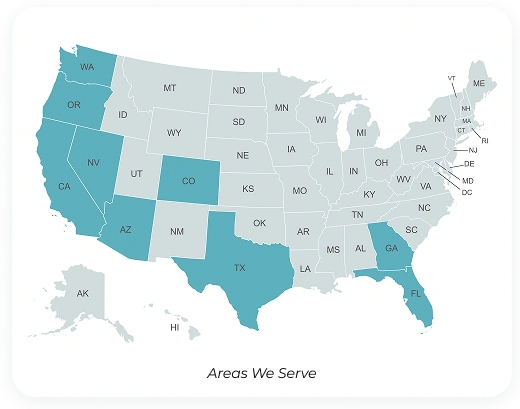
Unlike solo practitioners limited to one location, we handle complex cross-border and multi-state surrogacy legal arrangements across California, Florida, Georgia, Texas, Colorado, Washington, Oregon, Arizona and Nevada, plus international cases. We have of-counsel arrangements in every state where compensated surrogacy is legal.

One-Stop Legal Support
We go beyond legal representation. Our team also helps arrange fund management, passport and travel documentation, and hospital and vital records coordination. One dedicated team managing every moving piece of your journey.

LGBTQ+ Family-Building Advocate
For many LGBTQ+ intended parents, surrogacy is the only path to a biological family. We understand that reality and we're proactive advocates for LGBTQ+ family building, with a legal team that truly gets the complexities you're navigating.

Rich Geisler
Principal & Founder

Erin O. Allen
Senior Associate Attorney

Megan Gruter
Associate Attorney

David Hinton
Associate Attorney
Words from Our Families
Frequently Asked Questions
What the Surrogacy Contract Must Cover?
A comprehensive Surrogacy Contract is a legally binding document that protects both the Intended Parents (IPs) and the surrogate. Hence, a valid contract must explicitly cover these core areas:
- Establishment of Parental Rights: A clear, legally binding declaration that the Intended Parents are the sole legal and financial parents of the child and that the surrogate (and her spouse, if applicable) has no parental rights or obligations.
- Finances and Compensation: A detailed schedule of the surrogate's base compensation, monthly allowances (e.g., for maternity clothes, travel, and groceries), coverage of all medical expenses, health insurance premiums, lost wages, and the management of the independent escrow account.
- Medical and Liability Decisions: Agreements regarding the embryo transfer process, prenatal care, and critical decisions like selective reduction or termination of pregnancy in the event of severe medical anomalies.
- Lifestyle and Behavioral Guidelines: Mutually agreed-upon restrictions for the surrogate during the pregnancy, including dietary choices, travel limitations, abstinence from alcohol/nicotine/drugs, and adherence to medical advice.
- Contingency Plans: Provisions addressing unexpected outcomes such as miscarriages, stillbirths, carrying multiples, required bed rest, or a breach of contract by either party.
- The Birth Plan: Logistics for the delivery, including who is permitted in the delivery room, who makes immediate medical decisions for the baby, and how the birth certificate process will be handled.
Because surrogacy laws are state-specific in the US, the Intended Parents and the surrogate must be represented by separate, independent legal counsel licensed in the state where the birth or contract is governed to ensure it is legally enforceable.
Can a Close Friend Serve as My Surrogate?
Yes. This is often called identified or compassionate surrogacy, and it can be a deeply meaningful arrangement. But legally, it's treated the same as matching with someone you've never met and, in some ways, requires even clearer boundaries because of your existing relationship. Your friend will still need to pass medical and psychological screening, and you'll each need separate, independent legal counsel. You cannot share an attorney.
A Gestational Carrier Agreement must be fully signed before any medical procedures begin, addressing compensation, medical decision-making, and contingency planning. Depending on your state, your attorneys will also secure a pre- or post-birth order establishing you as the legal parent(s). Because surrogacy laws vary significantly by state, it's worth talking to an attorney early, even with a close friend, as a clear legal agreement is what protects the relationship as much as the outcome.
Is Compensated Surrogacy Legal in Every State?
No. Surrogacy law varies significantly from state to state, and there is no federal law governing it. Before pursuing surrogacy, it's important to confirm that the state where your surrogate lives and will give birth is surrogacy-friendly and legally recognizes both the surrogacy process and your parentage. States like California and Washington are considered surrogacy-friendly, with clear legal pathways for intended parents. Other states are far more restrictive. Nebraska, for instance, treats compensated surrogacy contracts as void and unenforceable, and Louisiana permits only uncompensated surrogacy for married heterosexual couples, which is an important consideration for LGBTQ+ intended parents weighing where to pursue their journey.
An agency may tell you a state is workable, but the legal hurdles often surface later in the process. Talking to a fertility attorney before you begin lets you map out your state-specific options from the start. That early guidance is often what makes the difference between a smooth journey and unexpected complications.
What Should I Ask Before Hiring a Fertility Attorney?
Surrogacy law moves quickly. Look for an attorney who works in this field daily, not a general family lawyer who handles it occasionally. Here's what to ask in your initial consultation:
Experience & Specialization
- What percentage of your practice is dedicated to Assisted Reproductive Technology (ART) law?
- How many Gestational Carrier Agreements have you drafted or reviewed in the past year?
- Are you a Fellow of the Academy of Adoption and Assisted Reproduction Attorneys (AAAA)?
Jurisdiction & Court Experience
- How many parentage orders have you secured in the county where my surrogate plans to give birth?
- If my surrogate lives in a different state, how do you handle cross-border legal coordination?
Fees & Transparency
- Do you charge a flat fee for the GCA and parentage phases, or bill hourly?
- Does your fee include court filing costs, or are those billed separately?
- Do you require an independent escrow company, or does your firm manage escrow funds directly?
What Does Legal Representation Typically Cost?
As the intended parents, you're responsible for both your own legal fees and your surrogate's independent legal fees, since you can't share an attorney. Costs generally break down into two phases: drafting and finalizing your Gestational Surrogacy Agreement before any medical procedures begin, and establishing parentage through a pre- or post-birth court order during the pregnancy.
Most reproductive attorneys offer flat fees for these standard phases rather than unpredictable hourly billing. A few factors can add to your overall cost, such as independent escrow management or coordinating with a local attorney if you and your surrogate live in different states. Because every journey is different, the clearest way to understand your specific costs is a consultation with our team.
Our White Paper On The Surrogacy Law Landscape
Surrogacy In A Post-Dobbs World: Navigating Challenges And Mitigating Risks